Working Prototype Demonstrated

Preventing Mis-Drills in Aerospace Manufacturing

Disposable sensor inlays detect drilling errors the instant they happen. 100 ms alarm, sub-0.1 mm accuracy, zero FOD. The only solution that prevents — not just detects.

Aerospace manufacturing with sensor technology
100 ms
Alarm Response
<0.1 mm
Location Accuracy
100%
Detection Rate
Zero
False Positives
Prototype Demo

See the sensor inlay in action

Working lab prototype with deterministic breach detection. No AI, no cameras — physics-based and fail-safe.

The Problem

The $2–8B Crisis Nobody Can Prevent

$2–8 Billion / Year1
Annual industry losses from mis-drilled fastener holes in aerospace manufacturing.
9.8 Billion Holes / Year2
Drilled across the aerospace industry with a mis-drill rate of 0.3–3.7%.
$500K–$2M Per Panel3
Cost of a single scrapped composite panel due to a mis-drilled hole.
1 Based on Tier-1 supplier analysis and industry hole volume estimates (Infra SSR MRO Whitepaper 2025).
2 Derived from OEM production rate data and fastener count per shipset across major aircraft programs.
3 Composite panel replacement cost range validated against published Spirit AeroSystems and Boeing supplier data.

Current methods only detect after damage.

Cameras, laser trackers, and NDT systems inspect holes after they're drilled. None of them prevent the damage in real time. The problem is invisible until it's too late.

  • Scrapped composite panels worth $500K–$2M each
  • Re-certification delays across production lines
  • Extended aircraft delivery schedules
  • Regulatory penalties and audit failures
  • Boeing delayed ~50 737 MAX deliveries due to Spirit mis-drilled holes (Reuters, Feb 2024)
Our Solution

Detects and Prevents Location-Based Mis-Drills

The system maps precise safe zones for every allowed fastener hole. Any drill breach outside these zones triggers an immediate alarm with exact location — stopping errors before they become structural defects.

This capability directly addresses one of the most expensive failure modes in composite and metallic assembly.

A thin, disposable sensor inlay sits behind the drill jig. After drilling, it is removed — zero weight, zero FOD added to the aircraft. Physics-based, deterministic detection with no AI tuning risk.

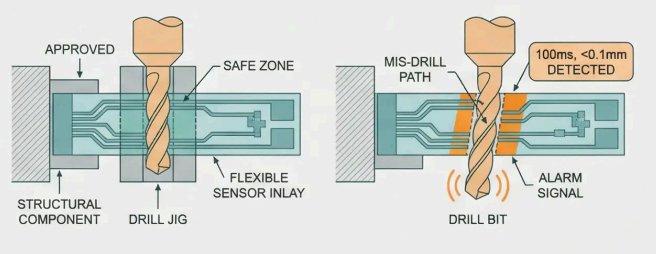
Sensor inlay detection diagram — safe zone vs mis-drill path

100 ms Real-Time Alarm

Breach outside the allowed window triggers an instant alarm with exact location at sub-0.1 mm resolution.

🔬

Physics-Based Detection

Deterministic trace-grid interruption. No AI, no cameras, no lighting dependency. Fail-safe by design.

🛡️

Zero FOD, Zero Weight

Temporary manufacturing aid removed after drilling. Nothing left on the aircraft — no certification required.

📐

Pre-Mapped Safe Zones

Safe zones pre-mapped for each allowed fastener hole. Correct holes break only expected traces.

🔌

Quick Plug & Play

20–30 second setup. Single edge connector into station cable. Supports 4–8 inlays per station.

📊

Data Logging

Rugged control box logs every drilling event. Optional lockout capability for safety-critical operations.

Process

How It Works

01

Place Inlay

Sensor inlay positioned behind the drill jig, aligned to structural component.

02

Detect Breach

Drill penetrates outside safe zone — instant alarm + precise fault location.

03

Correct in Real Time

Operator corrects immediately before damage propagates. Prevention, not rework.

04

Remove & Continue

Inlay removed after drilling. Aircraft remains unchanged. Zero FOD, zero weight.

Advantages

Key Benefits

💰

Immediate ROI

6–10 week payback for Tier-1 suppliers. $7.6M annual loss reduced to under $1.1M implementation cost.

✈️

Zero FOD / Zero Weight

Temporary manufacturing aid only. Nothing permanent on the aircraft — eliminates certification overhead.

📋

Regulatory Simplicity

Classified as tooling, not a flight-certified part. Shop-floor qualification — similar to drill jigs and fixtures.

🌐

Platform Scalability

Same architecture extends to nuclear, subsea, defence, and satellite applications.

Comparison

The Only Solution That Prevents in Real Time

TechnologyPrevents?Real-Time?Composites?Zero FOD?
Cameras / AINoSometimesLimitedYes
Laser / NDTNoNoYesYes
Infra SSR MROYes ✓100 ms ✓Yes ✓Yes ✓
Opportunity

Market Opportunity

$128M
Beachhead SOM
Hardware + Software
$160–200M
Total Addressable Market
20% Market Share Target
$320–500M
Exit Valuation
10–12x Revenue Multiple

Unit Economics

Composite shipsets / year~2,600
Inlays per shipset~1,100
Blended ASP$45
Gross margins at scale75%+
Target: 20% market share by 2032$32–40M ARR
Timing

Why Now

Composite Adoption Surging

Composite usage in new aircraft platforms is accelerating, increasing the volume of precision drilling operations.

Regulatory Pressure Rising

OEMs face increasing pressure on quality and traceability. Prevention tools with measurable ROI are actively sought.

No Certification Overhead

Tooling classification enables rapid deployment without aircraft recertification cycles — fast time-to-revenue.

Beyond Aerospace

Broader Platform Potential

The same physics-based sensor technology extends naturally to high-precision manufacturing sectors such as firearms production, defence, and critical infrastructure — offering multiple future revenue streams beyond the aerospace beachhead.

Founder & Milestones

Team & Execution Plan

Shahid Hussain
Founder & Inventor · Full-Time Committed

Developed working prototype and complete technical architecture from concept through lab validation. Patent application in preparation (filing targeted Q2 2027). Targeting first paid pilots ahead of MRO Middle East Dubai 2028. Seeking experienced aerospace advisor post-raise.

2026
Raise £1M pre-seed + finalise design
Q2 2027
Gerbers + production-grade prototypes
Q4 2027
Production-ready inlays
Feb 2028
Live demos at MRO Middle East Dubai
2028–29
Paid pilots + initial revenue
Infra SSR MRO
Real-time prevention for precision aerospace manufacturing.
Get Started

Ready to Partner or Invest?

Working prototype demonstrated. Pre-seed deck available. Let's talk.

or send a message directly